
Die Casting vs Metal Injection Molding: How to Choose
/ Uncategorized / By
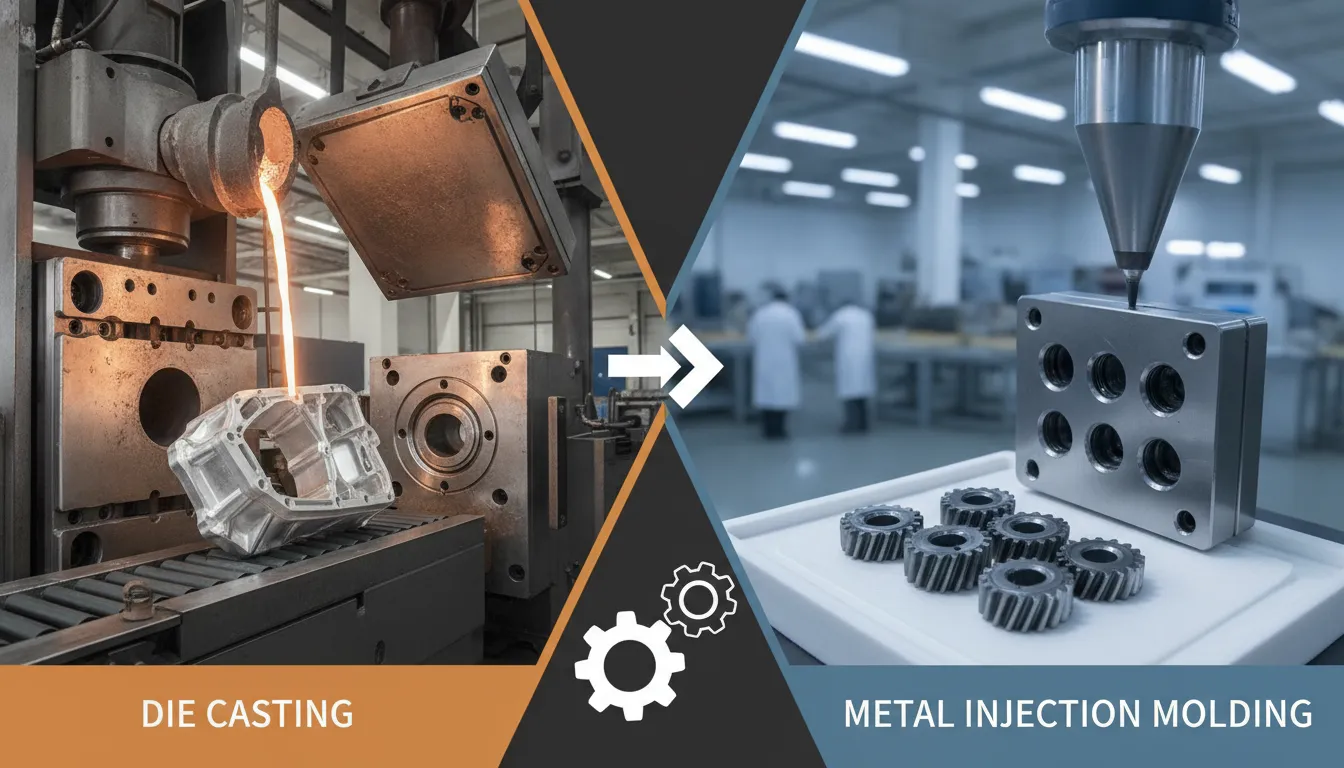
A part can look straightforward on a drawing and still present important manufacturing questions. How small are its features? Which alloy can meet its performance needs? How many units will you produce, and what finishing or machining will the part require? These details shape the decision around die casting vs metal injection molding. Die casting forms molten metal in a reusable steel die, while MIM molds metal powder feedstock and then uses debinding and sintering to create a solid component. Each process has distinct design and production considerations. Read on to compare geometry, materials, tolerances, tooling, lead times, and volume, so you can prepare more informed questions for your engineering and manufacturing partners.
Key Takeaways
- Choose based on part requirements: Compare size, geometry, material, performance needs, and expected production volume to assess whether die casting or MIM is a better fit.
- Share clear specifications early: Provide drawings, critical tolerances, operating conditions, and order forecasts so engineering teams can evaluate materials, design, and process risks.
- Plan for the finished component: Include tooling, lead time, inspection, machining, finishing, and assembly when comparing suppliers and estimating total production costs.
What Is Die Casting, and How Does It Work?
Die casting shapes metal parts by injecting molten alloy into a reusable steel mold, known as a die. The process is well suited to repeat production of components with detailed features and consistent dimensions. A successful result depends on coordinating the material, tooling, part design, and any finishing or inspection steps the component requires.
Inject molten nonferrous metal into a reusable steel die
The process starts by melting a nonferrous metal alloy, commonly aluminum, zinc, or magnesium. A die casting machine injects the molten metal under high pressure into a steel die with a cavity shaped to match the component. The die’s halves close during injection, containing the metal as it fills the cavity.
The combination of pressure, material, and die design helps create parts with defined features and a smooth surface. The specific setup depends on factors such as the selected alloy, part dimensions, geometry, and expected production volume. These considerations are worth reviewing before tooling begins, since they can affect both the design of the die and the production plan. This overview of die casting explains the process and its common material options.
Cool, eject, trim, and inspect parts
After the cavity fills, the metal cools and solidifies. The die opens, and an ejector system releases the casting. Excess material left by the metal’s path into the cavity, such as runners and gates, is trimmed away before the part moves to inspection or further processing.
Inspection confirms that the casting meets its dimensional and quality requirements. Depending on the component and its application, additional steps may include machining, surface finishing, or testing. These operations should be considered as part of the production plan, rather than treated as afterthoughts. They can affect the final part’s cost, lead time, and suitability for assembly. A manufacturing partner can help map the full process, from casting through inspection and any required secondary operations.
Use alloys such as aluminum, zinc, and magnesium
Aluminum, zinc, and magnesium alloys offer different properties, so the right choice depends on what the part must do. Aluminum may be suitable when relatively low weight is important. Zinc can support the production of detailed components, while magnesium is another option when reducing weight is a priority. The specific alloy should be selected against the component’s requirements, including strength, corrosion resistance, wear, and operating temperature.
Material choice also affects manufacturing decisions. An alloy can influence casting behavior, tooling needs, machining, finishing, and cost. Define performance requirements early and review them alongside the part design and expected volume. EMS Technologies provides die casting and other manufacturing services, with engineering support to help connect production decisions to project requirements.
Account for die design, draft, and part geometry
A die must allow molten metal to fill the cavity and the finished casting to release cleanly. Features such as wall thickness, ribs, corners, and transitions can influence how metal flows and solidifies. Designers also account for draft, a slight taper on surfaces parallel to the direction the part moves when it leaves the die. Without suitable draft, ejection can become difficult and may damage the part.
Complex features may be achievable, but they should be reviewed for manufacturability before tooling is finalized. Adjusting geometry early can support more consistent filling and ejection, and may reduce the need for secondary machining. A design-for-manufacturing review can help teams balance functional requirements with practical tooling and production needs. The die casting process overview also identifies die design, draft angles, and part geometry as key considerations.
What Is Metal Injection Molding (MIM), and How Does It Work?
Metal injection molding, or MIM, combines metal powder processing with the shaping capabilities of plastic injection molding. It is commonly used to make small, detailed metal parts in high volumes, especially when a component’s geometry would make machining complex or wasteful. The process has four main stages: preparing the feedstock, molding it, removing the binder, and sintering the part.
Blend fine metal powder and binder into feedstock
MIM starts with fine metal powder mixed with a binder, which helps the mixture flow into a mold and hold its shape after molding. Together, these materials form a feedstock with a consistency suited to injection molding. The metal powder supplies the component’s metal content, while the binder makes the mixture easier to shape.
A consistent blend is important for filling the mold reliably and producing repeatable parts. MIM can be a good fit for components with detailed features or complex shapes that would take several machining steps to create. The MIM process overview explains how feedstock preparation begins the production sequence.
Mold, debind, and sinter the feedstock
The prepared feedstock is injected into a mold to form a “green part.” It contains both metal powder and binder, so it is not yet a finished metal component. During debinding, the binder is removed in a controlled process, leaving a fragile part made primarily of metal particles.
The part is then heated during sintering. The metal particles bond together, forming a solid component. Sintering also causes the part to shrink, so the tooling and production process must account for the change in size. Manufacturers control factors such as temperature, atmosphere, and process timing to meet dimensional and material requirements. A MIM process video illustrates these stages, from molding through sintering.
Use stainless steel, low-alloy steel, or specialty alloys
MIM can be used with stainless steel, low-alloy steel, and specialty alloys. The right material depends on the part’s job and the conditions it will face. Strength, corrosion resistance, wear, and operating temperature are all worth considering, along with material availability and production requirements.
Evaluate the finished part against its intended use rather than relying on an alloy name alone. A component exposed to moisture or repeated movement may need different properties from one protected inside an assembly. Compare MIM with other processes, including die casting, based on geometry, performance needs, and expected volume. OptiMIM’s process comparison offers additional context on MIM materials and applications.
Account for shrinkage during sintering
As the metal particles bond during sintering, the part becomes smaller and denser. Engineers account for this shrinkage when designing the mold so the finished component can meet its target dimensions. Consistency matters: variation in shrinkage can affect accuracy, fit, and the way the part connects with neighboring components.
For buyers, an early design review helps surface these considerations before tooling begins. Share critical dimensions, tolerances, and interface requirements with the manufacturing team. Engineers can assess whether the geometry suits MIM and whether any features may need tighter process controls or secondary machining. EMS Technologies’ engineering and manufacturing services can support this kind of review as part of a broader production plan.
How Do Die Casting and MIM Differ?
Die casting and metal injection molding (MIM) can both produce complex metal components, but they suit different combinations of part size, geometry, material, and production requirements. Die casting forces molten metal into a reusable steel die. MIM shapes a blend of metal powder and binder, then removes the binder and sinters the part.
To compare the processes, look beyond the shape that comes out of the tool. Consider the finished part’s dimensions, critical features, performance needs, and any machining or finishing it requires. These details help determine which process makes sense for your design and production plan.
Compare part size, weight, and wall thickness
Die casting is often a practical option for medium-to-large parts that need a rigid structure, such as housings, brackets, and enclosures. Common die-cast materials include aluminum, zinc, and magnesium alloys. The process can produce complex shapes and smooth surfaces, and YIZUMI’s overview describes its use for strong, durable components, including larger parts.
MIM is generally used for smaller components where compact dimensions and detailed geometry matter. It can form shapes that would take substantial machining to produce from solid stock. However, practical part size and wall thickness depend on the material, design, and production equipment. Neither process automatically produces a lighter part. Weight depends on the component’s dimensions, alloy, and strength requirements. Share these requirements with a manufacturing engineer before choosing a process.
Assess intricate features, thin walls, and undercuts
MIM can form small features, including ribs, holes, and detailed contours, directly into a component. This may reduce machining or eliminate the need to assemble several pieces. It can be useful when a compact part has intricate geometry that would be difficult or costly to produce through conventional machining.
Die casting also accommodates complex shapes, but features need to work with the die’s opening direction and the flow of molten metal. Undercuts may call for additional tooling, while thin walls require careful design to support consistent filling and cooling. MIM has different design considerations, including powder flow and shrinkage during sintering. Review ribs, holes, and undercuts with an engineer early in the design process. Small changes may make either manufacturing route more feasible.
Compare tolerances, surface finish, and consistency
Both processes can produce repeatable parts, but dimensional accuracy and surface finish depend on the geometry, material, tooling, and process controls. Die casting can deliver smooth surfaces and good dimensional accuracy, potentially reducing the need for machining on some designs. YIZUMI’s discussion of die casting highlights these qualities for parts that require consistent dimensions.
MIM can also produce detailed, near-net-shape components, but sintering causes shrinkage that must be factored into tooling and process controls. Some dimensions may need machining or finishing to meet drawing requirements. Mark critical-to-function dimensions on your part drawing, then ask suppliers how they will measure and control them. EMS Technologies’ engineering and manufacturing services can help businesses assess process requirements as part of a broader manufacturing plan.
Evaluate density, porosity, strength, and pressure-tightness
A part’s strength depends on more than the process used to make it. Alloy, geometry, heat treatment, and process controls all affect performance. Die-cast parts can contain porosity, which may be a concern when a component must hold pressure or handle demanding loads. Before finalizing a design, discuss pressure-tightness requirements, inspection methods, and acceptance criteria with potential suppliers.
MIM parts are made from metal powder that is molded and sintered into a solid component. With an appropriate material and controlled production, MIM can produce dense parts with useful strength. OptiMIM’s process comparison covers density and porosity as factors in evaluating metal-forming processes. Request material data and test results for the specific grade and application. Avoid relying on general process comparisons when the part’s service conditions determine the performance requirements.
Identify machining, finishing, and other secondary operations
Compare the full manufacturing route, not just casting or molding. Die-cast parts may need trimming to remove gates and flash. Depending on the design and specifications, they may also require machining, coating, or surface treatment. MIM parts go through debinding and sintering after molding, and may need additional steps such as sizing, machining, heat treatment, or finishing.
Secondary operations affect cost, lead time, inspection, and assembly planning. A part with a lower initial forming cost may require more work before it meets the finished specifications. When requesting quotes, provide the part drawing, material requirements, surface finish, and expected annual volume. Ask each manufacturing partner to identify secondary operations and quality checks. This gives you a clearer basis for comparing the finished components and planning production.
What Are the Advantages and Trade-Offs of Each Process?
Die casting and metal injection molding (MIM) can both produce detailed metal parts, but they suit different materials, geometries, production needs, and performance requirements. Compare the complete manufacturing process, including tooling, post-processing, inspection, and assembly, rather than judging a method by its molding step alone.
Produce nonferrous parts quickly with die casting
Die casting forces molten metal into a reusable steel die under high pressure. The process is commonly used with nonferrous alloys such as aluminum, zinc, and magnesium. Once the metal cools, the part is ejected, trimmed, and prepared for inspection or finishing. With relatively short production cycles, die casting can be an efficient option for repeat production of complex parts with smooth surfaces.
That speed comes with design considerations. Wall thickness, draft, gates, and vents all affect how metal fills the die and how consistently parts can be made. Die casting also does not suit every alloy or component size. Confirm that the material and geometry meet the part’s requirements before committing to tooling. YIZUMI’s comparison of die casting and injection molding outlines common process strengths and limitations.
Address porosity and complex features through design changes
Porosity can occur in die-cast parts when gas or shrinkage leaves voids in the metal. The risk matters most when voids could affect a component’s function, such as in a part that must contain pressure or withstand a specific load. Discuss the part’s use, inspection criteria, and acceptable limits with your manufacturing partner before finalizing the design.
Design changes may help improve metal flow and reduce quality concerns. Adjustments to wall thickness, gates, vents, or the placement of critical features can support more consistent filling. Keep machining in mind, too, since cutting into a part can expose pores below the surface. MIM can form details such as holes and ribs directly into a part, which may reduce the need for complex machining. Review the complete process with engineering before selecting a design.
Form small, intricate parts with MIM to reduce assembly needs
MIM combines fine metal powder with a binder to create feedstock that can be molded into detailed shapes. After molding, parts go through debinding and sintering to create solid metal components. This approach can suit small, intricate parts with features that may be difficult or expensive to machine. Forming multiple details into one component may also reduce the number of separate pieces and assembly steps.
MIM still needs to be evaluated against part size, material, tolerances, expected volume, and post-processing needs. A design that works well for MIM may not be cost-effective at every production quantity. Ask whether the process can meet the finished part’s requirements, not just reproduce its geometry. OptiMIM’s process comparison explains how MIM can produce near-net-shape parts with delicate features.
Allow for MIM’s added debinding and sintering time and controls
MIM includes extra production stages after molding. Debinding removes the binder from the molded feedstock, then sintering heats the part so the metal particles bond into a solid component. These steps add time and require process controls to support consistent results. The part also shrinks during sintering, so its design and production process must account for final dimensions.
For this reason, the molding cycle alone does not show MIM’s full lead time or production capacity. Ask how the supplier manages shrinkage, checks dimensions, and controls each stage. Include inspection, finishing, and any other secondary operations when estimating schedule and cost. If your part is part of a larger product, consider how MIM fits with other manufacturing steps. EMS Technologies’ manufacturing services include engineering and program management support across production.
Compare finished-part performance, not just molded geometry
A part can match its intended shape and still fall short in service. Compare the finished component against its requirements for strength, weight, corrosion resistance, temperature, wear, tolerances, and pressure-tightness. Both the material and process affect performance, so validate the complete specification rather than assuming a process will deliver a particular result.
Die casting may suit nonferrous components that need complex shapes and efficient production at volume. MIM may be a better fit for small, detailed metal parts where near-net-shape production can reduce machining or assembly. For either method, confirm material properties, inspection criteria, and any finishing requirements with your supplier. Sharing the part’s operating conditions early helps the engineering team assess process fit and plan for the component’s intended service life.
Which Materials and Performance Requirements Should You Consider?
Start with what the finished part needs to do, then assess which material and process can meet those needs. Strength, corrosion resistance, wear, temperature, pressure, and service life all matter. Share these requirements with your manufacturing partner early so its engineering team can review material options, part design, and any secondary operations.
Match alloys to strength, corrosion, wear, and temperature needs
List the loads the part will carry, the chemicals or moisture it may encounter, the surfaces that will experience friction, and its expected temperature range. Then compare specific alloys against those conditions. Die casting commonly uses aluminum, zinc, and magnesium, with each alloy offering different characteristics. Aluminum may suit lightweight components, while another alloy may better meet a particular strength or wear requirement.
MIM can use stainless steel, low-alloy steel, and specialty alloys. Ask suppliers for data on the exact grade and finished part, rather than relying on general descriptions such as “corrosion resistant.” OptiMIM’s process comparison explains how metal powder is molded and sintered to form precise components. The best material depends on the part’s working environment and performance targets.
Evaluate properties based on material and process
Material properties are only part of the picture. The manufacturing process also affects a part’s dimensions, surface finish, density, and mechanical performance. Die casting uses high pressure to shape molten nonferrous metal, making it suitable for producing precise parts with complex shapes. YIZUMI’s overview of die casting describes how the process can produce strong, durable components with smooth surfaces.
MIM combines metal powder with a binder, then uses debinding and sintering to create the finished part. It can form detailed features that may be difficult or costly to machine. Ask for performance data that reflects the chosen alloy, process, and finished condition, including any heat treatment or other secondary work.
Check porosity, pressure-tightness, and post-processing needs
If a part must contain gas or fluid, withstand pressure, or provide a sealing surface, discuss porosity and pressure-tightness during the design review. Porosity in a die-cast part can affect leak performance or strength, depending on the part and its requirements. MIM parts can achieve high density through sintering, but the finished component still needs to be tested against its intended use. Neither process alone guarantees that a part will be pressure-tight.
Ask what inspections or tests can verify performance, such as leak testing or dimensional checks. Also identify any machining, coating, heat treatment, or finishing the component will need. These operations can affect cost and lead time. An early engineering review of manufacturing services can help identify process and post-processing needs before production planning is complete.
Confirm operating conditions, service life, and applicable specifications
Turn performance expectations into clear, measurable requirements. Document operating temperatures, load cycles, exposure to chemicals or moisture, expected service life, and any customer or industry specifications. For safety-critical or regulated applications, establish requirements for material certifications, traceability, inspection, and validation before production begins.
Ask your manufacturing partner to explain how the proposed alloy and process will meet each requirement, and what evidence it can provide. This may include material certifications, dimensional reports, or test results. Include expected production volume in the discussion, too: die casting often requires a higher initial tooling investment, which can make it cost-effective for large production runs. EMS Technologies’ engineering and program management support can help connect performance goals with design and production planning.
How Do Tooling Costs, Lead Times, and Volumes Compare?
Compare the full cost and schedule for producing a finished part, not just the initial tooling quote or the price per piece. Die casting and metal injection molding (MIM) each involve tooling, production, inspection, and often secondary operations. Their economics depend on the part’s dimensions and geometry, the material, the required finish, and the number of parts you expect to order.
Die casting often calls for a higher initial mold investment, while MIM adds debinding and sintering after molding. Those differences affect both lead time and production planning. A fast machine cycle, for example, does not account for tool construction, qualification, or finishing. Likewise, a low quoted unit price may assume a production volume that does not match your forecast.
To make a useful comparison, ask suppliers to price realistic quantities and explain what each estimate includes. Review expected tool life, maintenance, inspection, scrap, finishing, machining, and assembly. It also helps to compare the launch schedule with the steady-state production schedule, then consider how costs and timing could change if demand or the design shifts. Involving engineering and program management early can help identify cost and schedule factors before tooling begins. EMS Technologies’ manufacturing services include engineering and program management support across production needs.
Compare tooling design, investment, maintenance, and tool life
Die casting typically requires a durable steel die designed to withstand repeated cycles and exposure to molten metal. The die’s design must account for the parting line, draft, cooling, and ejection. This can make the initial investment significant, but the cost may be spread across a large production run. YIZUMI’s process comparison notes that die casting’s higher mold cost can become cost-effective at higher volumes.
MIM tooling also requires upfront investment, with the design accounting for part geometry and shrinkage during sintering. For either process, ask suppliers about expected tool life, maintenance intervals, repair costs, and the cost of future modifications. These details help you evaluate the total investment over the life of the program, rather than relying on the initial tooling price alone.
Account for design-driven tooling costs and lead times
Part geometry affects both tool cost and timing. Complex shapes, tight tolerances, thin walls, side actions, and features that are difficult to release can add design and manufacturing work. Before tooling starts, ask engineering to review the part for manufacturability. That review can identify features to simplify and clarify which dimensions need close control.
Lead times depend on part size, complexity, toolmaker capacity, material availability, and design revisions. Some suppliers advertise short MIM tooling timelines for small parts, but those claims apply to specific designs and conditions. Request a schedule that separates tool design, tool construction, sampling, inspection, and approval. EMS Technologies’ engineering and program management teams can help coordinate the work and clarify dependencies before production planning is finalized.
Compare die casting cycle rates with MIM debinding and sintering
Once a die is ready, die casting can produce parts through repeated cycles of injection, solidification, and ejection. Actual output depends on part size, cooling requirements, cavity count, alloy, and the time needed for trimming and inspection. A fast cycle rate alone does not determine the overall delivery schedule, because tooling, sampling, and process qualification also take time.
MIM adds debinding and sintering after the feedstock is molded. These steps remove the binder and consolidate the metal powder, extending the production route beyond the molding cycle. Inspection after sintering also needs to be included in the plan. When comparing supplier estimates, ask for expected good-part output per shift or week, along with assumptions about yield and scheduled downtime. This gives you a more useful view of delivery capacity than machine cycle time alone.
Estimate unit costs at realistic production volumes
The most economical process depends in part on how many parts you need and how demand may change. Die casting’s higher initial tooling cost can be justified when production volume is high enough to distribute that expense across many parts. MIM can create dense, near-net-shape components, potentially reducing the amount of machining required. OptiMIM’s process comparison describes MIM’s scalability and potential cost advantages compared with traditional machining.
Ask suppliers to quote several quantities, including the launch order, expected annual demand, and a higher-volume scenario. Check whether estimates include scrap, tool maintenance, packaging, and order frequency. A low unit price based on a volume you may not reach can give a misleading picture. Compare total program costs at quantities that reflect your forecast and purchasing plan.
Include inspection, finishing, machining, and assembly costs
The quoted price for a molded or cast part may not include every operation required to meet the drawing or customer specifications. Die-cast components may need trimming, machining, surface treatment, or inspection for porosity and critical dimensions. MIM parts may also need machining, finishing, and dimensional checks after sintering. Some parts require post-processing even when the forming process can produce complex shapes consistently, as YIZUMI explains.
Ask suppliers to itemize secondary operations and inspection methods, including any fixtures or gauges. If the component will be assembled with other parts, include assembly labor, fasteners, and inspection in the comparison. Reviewing the full production route helps you identify costs that may not appear in the initial piece-price estimate.
Reassess costs when demand or design changes
Your initial process decision should account for both current requirements and plausible changes to the program. If volume rises, a larger tooling investment may become more economical per part. If demand is uncertain or remains low, flexibility may matter more than the lowest projected unit price. Discuss volume ranges with suppliers and ask how each process would accommodate a faster ramp-up, a delayed launch, or a revised forecast.
Design changes can affect tooling, sampling, qualification, and delivery dates. Before approving a revision, confirm whether it requires a tool modification or replacement, and whether parts already in production are affected. Keep engineering, sourcing, and program management aligned on revision control, approvals, and cost responsibilities. With those details clear, your team can assess the impact of a change before it affects production plans or customer commitments.
Where Do Manufacturers Use Die Casting and MIM?
Die casting and metal injection molding (MIM) serve different part requirements. Die casting is commonly used for durable nonferrous components, while MIM can form small metal parts with intricate details. Industry can help narrow the options, but the final choice depends on the part’s size, shape, material, performance needs, and production volume.
Use die casting for automotive, electronics, and industrial components
Die casting suits components that need precise dimensions, complex shapes, and smooth surfaces. Automotive manufacturers use it for parts such as engine blocks and transmission housings. Electronics manufacturers may use die-cast metal for equipment housings and heat sinks, while industrial companies apply it to durable components for machinery and equipment.
The process commonly uses aluminum, zinc, or magnesium alloys. Each material has distinct properties, so selection should reflect the part’s operating environment and performance requirements. For example, a housing may need to protect sensitive electronics, while an automotive component may need to withstand repeated mechanical loads. YIZUMI’s overview of die casting applications provides further examples and process considerations.
Use MIM for small, detailed medical, aerospace, and consumer parts
MIM is suited to small metal components with intricate features that may be difficult or costly to machine. The process can form details such as small holes and ribs, making it an option for certain medical, aerospace, consumer, and retail applications. Because MIM produces near-net-shape parts, it may also reduce the material removal needed during finishing.
The process includes molding, debinding, and sintering, so teams need to account for each stage when planning production. Sintering can change a part’s dimensions, which makes process controls and careful design important. MIM is not automatically the right choice for every small component: alloy, tolerances, production volume, and finishing needs all affect its suitability. Assess these requirements early to determine whether MIM can meet both the part specification and the production plan.
Match applications to size, geometry, material, and volume
Start with the part’s dimensions, wall thickness, features, and tolerances. Then define the conditions it must withstand, including loads, temperature, wear, and exposure to corrosive environments. These details help engineers identify suitable materials and rule out processes that cannot meet the design or performance requirements.
Production volume matters as well, since tooling investment and unit costs change with scale. A small component with intricate geometry may be a candidate for MIM, while a larger part made from a nonferrous alloy may suit die casting. Neither the industry nor the part’s shape alone should decide the process. Consider material, design, performance, and expected demand together. YIZUMI’s process comparison also emphasizes evaluating part requirements and production scale when selecting a manufacturing method.
Fit either process into the broader manufacturing plan
The forming method is one part of the production plan. Include tooling, inspection, machining, finishing, and assembly in the evaluation, and confirm how each step will be managed. These decisions influence the cost and lead time of the finished product, not just the cost of the individual part.
An engineering review can identify design adjustments that support manufacturability while preserving function. It can also clarify how a component fits into a larger mechanical or electronic assembly. EMS Technologies offers engineering, program management, and manufacturing services, including die casting, machining, PCB and cable assemblies, and turnkey assembly. Its listed services include die casting and plastic injection molding, but not MIM. If MIM is under consideration, confirm process availability and responsibilities with your manufacturing partners before finalizing the production plan.
How Should You Choose Between Die Casting and MIM?
The right choice between die casting and metal injection molding (MIM) starts with the part’s requirements, not a preference for one process. Size, geometry, material, tolerances, annual demand, and production timing all affect which option makes sense. Die casting is commonly used for nonferrous metal parts, while MIM is often considered for small, detailed components. A manufacturer can confirm whether either process suits your specific design.
Before requesting quotes, prepare a part brief with a current drawing or 3D model, expected order quantities, product life, critical dimensions, and operating conditions. Include the features that may shape production, such as thin walls, undercuts, small openings, or surfaces that need machining. Clear inputs help manufacturers identify questions and provide estimates based on the same assumptions.
Compare the full production plan, not just the piece price. Tooling, material, cycle time, inspection, finishing, machining, and assembly all affect cost and delivery. A process that appears economical at one volume may be less suitable if demand changes or the part needs extensive secondary work. Use the following steps to structure your evaluation and discuss process fit with manufacturing and engineering teams.
Define part dimensions, geometry, tolerances, and annual demand
Start with the part’s overall dimensions, weight, wall thickness, and smallest features. Die casting is often used for components larger than those typically made through MIM, while MIM can be a fit for small parts with intricate geometry. These are general patterns, not fixed limits. The material, design, and supplier’s equipment also matter.
Mark critical dimensions and tolerances on the drawing, and identify where variation is acceptable. Then document your expected annual demand, initial order quantity, and product life. Volume can affect how tooling costs are distributed across production, so share realistic forecasts with each manufacturer. Providing the same drawing and volume assumptions to potential suppliers makes their recommendations and quotes easier to compare.
Set material and performance requirements before requesting quotes
Select a material based on how the part needs to perform. Die casting commonly uses aluminum, zinc, and magnesium alloys. MIM can use stainless steel, low-alloy steel, and other materials, depending on the supplier’s capabilities. Compare specific grades and their properties rather than assuming that every material made with a particular process will perform the same way.
Describe the part’s operating conditions, including loads, impact, vibration, corrosion, wear, temperature, and exposure to fluids. List requirements for strength, hardness, service life, and any applicable specifications. Ask how the selected material and process may affect porosity, pressure-tightness, or post-processing. If the part needs heat treatment, coating, or machining to meet its requirements, include those operations in the quote request.
Compare tooling, unit cost, lead time, and secondary operations
Request a cost breakdown that separates tooling from the per-part price. Die casting uses a reusable metal die, and its upfront cost may be more practical at higher production volumes. MIM also requires tooling, followed by debinding and sintering. Tooling costs, maintenance, tool life, and production capacity depend on the design and supplier, so ask what assumptions inform each estimate.
Compare the timeline from design approval through first production. Include sampling, approval, production scheduling, inspection, machining, and finishing. MIM’s debinding and sintering stages require additional time and process controls, while die-cast parts may need trimming or other secondary work. Ask for estimates at both your initial order quantity and projected annual demand to understand how unit costs may change as volume grows.
Review design for manufacturability with engineering and program management teams
Ask manufacturing engineers to review the drawing or 3D model before selecting a process. They can assess features such as wall thickness, draft, radii, parting lines, and openings, then identify design changes that may improve production consistency. For MIM, account for dimensional change during sintering. For die casting, consider how the part’s geometry may affect metal flow, cooling, and ejection.
Include program management in the review so design questions, material decisions, samples, testing, tooling, and production milestones stay coordinated. Early collaboration can uncover opportunities to simplify the part or reduce secondary work. EMS Technologies provides engineering and program management support to help customers address requirements across the manufacturing process.
Plan machining, finishing, and assembly around the chosen process
List every operation needed to meet the finished part’s requirements. This may include machining critical surfaces or holes, deburring, heat treatment, coating, plating, and inspection. Confirm which features can be produced through the primary process and which require additional work. These decisions affect cost, lead time, and dimensional control.
Consider how the part will fit into the final product. Note any fasteners, inserts, seals, electrical connections, or interfaces with neighboring components. If the part is part of a larger assembly, ask which operations a supplier can manage and which require coordination with other providers. Evaluate the complete delivered component, not only the part as it leaves the die-casting or MIM process. EMS Technologies offers machining and assembly services that can be considered as part of a broader production plan.
Consult a manufacturing partner early about process fit and production needs
Involve a manufacturing partner while the design can still change. Share the part model, preferred materials, performance requirements, projected volumes, and target schedule. Ask the team to explain why a process may fit, what assumptions support its recommendation, and what design or production risks need review before tooling begins.
Look for a partner with relevant manufacturing capabilities and the engineering and program management resources to coordinate the work. EMS Technologies provides die casting alongside mechanical and electronic manufacturing services, including machining, PCB and cable assemblies, and turnkey assembly. Its manufacturing capabilities can help you discuss die casting and related production needs. If you are also evaluating MIM, confirm that any prospective partner has the specific MIM expertise and equipment your project requires.
Frequently Asked Questions
Can die casting and MIM make the same part? Sometimes, but they are not interchangeable by default. The part’s size, geometry, material, performance requirements, and production volume help determine which process is suitable. Ask an engineer to review your drawing and operating requirements before choosing.
Which process is better for a small part with intricate details? MIM may suit small components with detailed features, while die casting is often used for larger parts made from nonferrous alloys. These are general guidelines, not fixed rules. The design and supplier’s capabilities also matter.
What information should I share when requesting a quote? Provide a current drawing or 3D model, material and performance requirements, critical tolerances, expected order quantities, and target schedule. Include any required machining, finishing, testing, or assembly so suppliers can estimate the full production route.
Does EMS Technologies offer MIM? EMS Technologies lists die casting and other mechanical and electronic manufacturing services, but not MIM. If your project requires MIM, confirm capabilities with a qualified MIM supplier. EMS can discuss die casting and related manufacturing needs, including engineering, machining, and assembly.
When should I involve a manufacturing partner? Bring one in while the design can still change, ideally before tooling is finalized. Early review can help identify design concerns, secondary operations, inspection needs, and schedule dependencies before they affect production planning.