
Metal Injection Molding vs CNC Machining: How to Choose
/ News / By
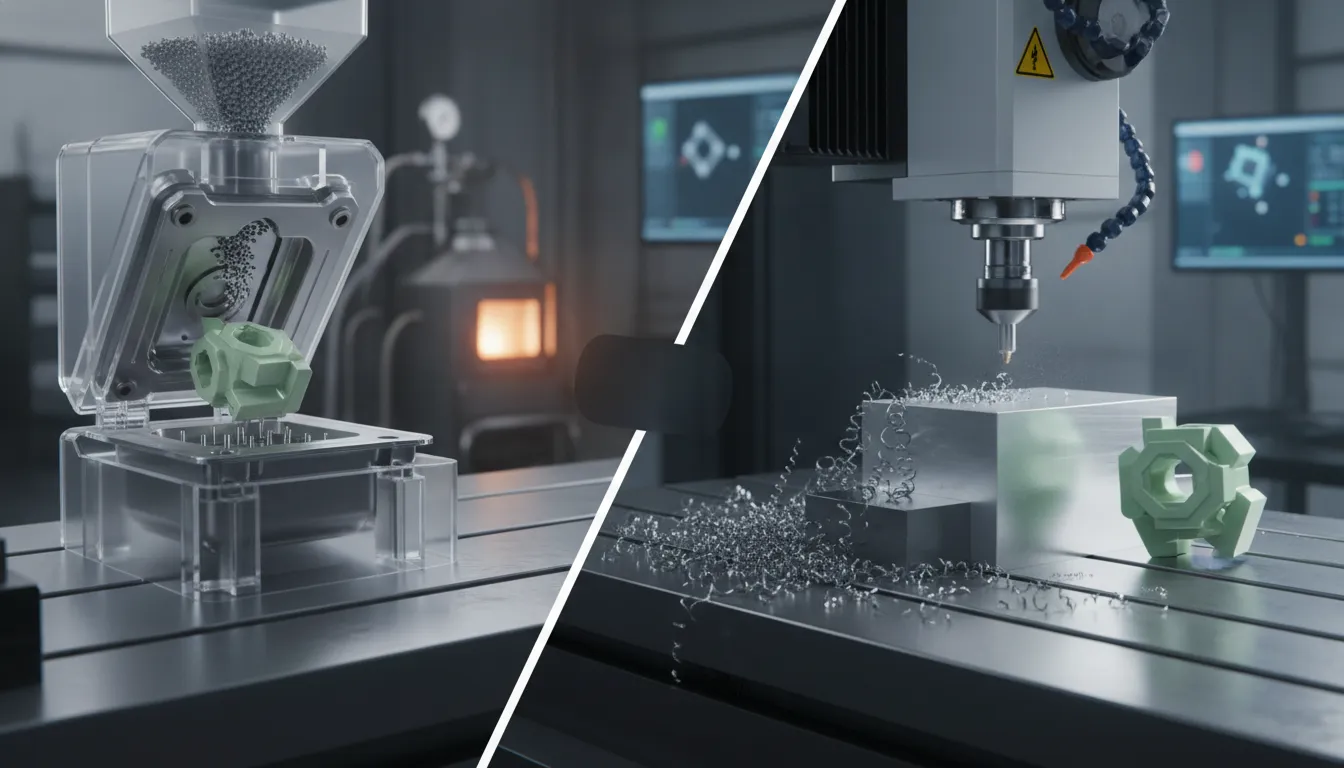
A metal part can look straightforward on a drawing and still raise a big production question: should you form it with metal injection molding or machine it from solid stock? The answer affects tooling costs, lead time, material use, design flexibility, and the price per part. Comparing metal injection molding vs CNC machining means looking beyond a single quote or tolerance figure. You’ll need to weigh the part’s geometry, material, finish, production volume, and potential design changes together. This guide breaks down how each process works, where each one tends to fit, and what to ask a manufacturing partner before committing to tooling or production.
Key Takeaways
- Choose the process around your part and demand: MIM can suit small, complex parts made in high volumes; CNC machining often works well for prototypes, lower quantities, and precision features.
- Compare total project costs: Include tooling, setup, material use, finishing, inspection, and lead time, then request estimates for realistic order volumes.
- Review requirements before production: Confirm materials, tolerances, geometry, and inspection needs with a manufacturing partner, and identify any secondary operations before committing to tooling.
What Is Metal Injection Molding (MIM), and How Does It Work?
Metal injection molding combines plastic injection molding with powdered metallurgy to produce small, detailed metal parts. It is often a fit for components with complex shapes and production volumes large enough to justify custom tooling.
Blend metal powder and binder
MIM begins with fine metal powder, often stainless steel or low-alloy steel, mixed with a polymer binder. The binder helps the powder flow through the molding equipment and hold its shape after it leaves the mold. Together, these materials form a feedstock that can be heated and injected.
Material selection depends on how the finished component will perform. Strength, wear resistance, corrosion resistance, and operating conditions all matter. The powder and binder also affect how the feedstock fills the mold, so part design and material choice should be considered together. OptiMIM’s overview of MIM explains how the process can form precise, complex metal parts.
Inject feedstock, remove binder, and sinter
A molding machine heats the feedstock and injects it under pressure into a custom mold. After cooling, the molded part is called a “green part.” It holds its shape, but the binder still makes up part of its structure, so the part has not reached its final strength or size.
Next, a controlled process removes the binder, leaving a fragile “brown part.” The part is then heated in a furnace. During sintering, metal particles bond together and the part becomes dense and strong. Each stage affects the final result, making process control important. XS Sights’ explanation of MIM outlines the molding, debinding, and sintering steps.
Plan for shrinkage, size, geometry, and post-processing
As the metal particles bond during sintering, the part shrinks. Engineers account for this change when designing the mold, then validate dimensions during production. Thin walls, uneven sections, and intricate features can make consistent results more challenging, so the part’s geometry should be reviewed early.
MIM is typically suited to small components with complex shapes. Larger parts may require more material and create added processing demands. Some components also need secondary operations, such as machining, heat treatment, or surface finishing, to meet final specifications. Include these steps in cost and production planning. Because tooling and feedstock require upfront investment, MIM can become more cost-effective at higher production volumes.
What Is CNC Machining, and How Does It Work?
CNC machining uses computer-controlled equipment to shape a part by removing material from a solid piece of stock. It can support prototype development and production, with the setup tailored to the part’s geometry, material, tolerances, and expected quantity.
Cut metal stock with controlled tools
CNC stands for computer numerical control. A machine follows programmed instructions to move cutting tools along specific paths, removing material until the stock matches the part’s design. Milling can create flat surfaces, pockets, and slots, while turning is often used for cylindrical features. Some parts require several operations or machines to reach their final shape.
CNC machining is also used with plastics and other materials, though metal parts are the focus here. The process is useful when a design calls for features to be cut directly into solid stock. This CNC machining overview explains how computer-controlled tool movement shapes material into a component.
Set up, machine, and inspect parts
Before machining begins, the team reviews the design, chooses appropriate cutting tools, and determines how to hold the stock securely. A CNC program sets the tool paths, cutting sequence, and machine settings. Once the machine is set up, it removes material through a series of planned operations. During prototyping or after a design change, the program or setup may need adjustments.
After machining, the part is checked against its drawing and specifications. Inspection may cover dimensions, tolerances, and surface condition. Defining these checks early helps confirm that the chosen process can meet requirements consistently, including when production quantities increase. EMS Technologies offers machining services alongside mechanical and electronic manufacturing capabilities.
Plan for tool access, fixturing, and material removal
Part geometry affects whether cutting tools can reach each feature. Deep cavities, narrow slots, and complex shapes may call for specialized tools, multiple setups, or design changes. Fixturing is just as important: it must hold the stock securely while leaving enough room for the cutting tool to work. An awkward setup can add machining time and make consistent results more difficult.
CNC machining starts with a block of material, so the team must plan how much stock to remove and in what order. That plan can affect cycle time, material waste, and the need for finishing work. Tight tolerances may require extra machining passes and inspection. Reviewing tool access, fixturing, and material removal early helps keep the design practical for production.
How Do MIM and CNC Machining Compare?
Metal injection molding (MIM) and CNC machining both produce metal parts, but they shape material in different ways. MIM forms parts in a mold, while CNC machining cuts material from a solid workpiece. Your best option depends on the part’s size and geometry, material requirements, tolerances, surface finish, and production volume.
Compare complexity, size, and design flexibility
MIM is designed for producing small parts with intricate features, including thin walls, curves, and details that can be difficult to machine. Once the mold is made, the process can reproduce those shapes across large production runs. MIM and CNC machining differ in how they handle complexity and volume, so assess both the part design and expected demand.
CNC machining can make complex parts, too, and it offers flexibility when a design may change. Updates typically involve revising the machining program rather than replacing a production mold. However, deep cavities, narrow channels, and hard-to-reach surfaces can require specialized tools or extra setups. MIM is generally associated with smaller components, while CNC can accommodate a wider range of part sizes, depending on the equipment and workholding. Review the geometry with your manufacturing partner before finalizing the design.
Compare materials, alloy properties, and density
CNC machining works with a broad range of materials, including aluminum, steel, brass, and plastics. That variety can be useful when a design calls for a particular grade or when you want to test different materials during development. CNC machining supports a wide range of material types, but availability still depends on the supplier and the part’s requirements.
MIM uses metal powder combined with a binder to create feedstock, so material choices depend on the available alloys and the manufacturer’s process capabilities. The parts are sintered to bind the metal particles, and their final density and mechanical properties depend on the material and process controls. Specify the required alloy, strength, density, and operating conditions early. Then ask your manufacturing partner to confirm that the proposed process can meet those requirements.
Compare tolerances, precision, and surface finish
CNC machining is often a strong option for features that require tight dimensional control. The cutting tool follows a programmed path to shape the part, and some providers report tolerances around ±0.001 inch. Actual results depend on the material, part geometry, machine, and inspection method, so confirm critical dimensions with your manufacturer. CNC machining can achieve tight tolerances, but a quoted capability should be checked against your specific design.
MIM forms parts close to their final shape, which can reduce the amount of finishing required. However, parts shrink during sintering, and the process must account for that change. Some features may need secondary machining or finishing to meet the drawing. Identify critical dimensions, surface finish expectations, and inspection requirements upfront so the process can be evaluated against the part’s functional needs.
Compare waste, speed, and secondary operations
CNC machining removes material from a solid block or bar, creating chips as it cuts. The amount of waste depends on the part’s shape and the starting stock. Machining can make sense for prototypes and smaller runs, but parts that require extensive material removal may take longer to produce and use more stock.
MIM forms parts near their final shape, which can reduce material waste and finishing work. It involves a mold investment, followed by debinding and sintering. Once the tooling is ready, production can be efficient, and the per-part cost may become more favorable at higher volumes. MIM’s cost structure changes with production volume, so compare the full process plan, including tooling, machining, finishing, and inspection. A manufacturing partner with engineering and production services can help identify operations that affect cost and delivery.
Distinguish MIM from plastic injection molding
MIM uses some principles of plastic injection molding, but it produces metal parts. Metal powder is mixed with a binder to form feedstock, which is injected into a mold. The binder is then removed, and the part is sintered to bond the metal particles. This process can create small, intricate components in larger quantities.
Plastic injection molding also pushes material into a mold, but it uses plastic rather than metal powder feedstock. The materials and processing steps lead to different properties and applications. When reviewing a quote or discussing a design, check which process the supplier means by “injection molding.” MIM combines molding with powder metallurgy, making it a distinct option from both plastic molding and CNC machining.
How Do Cost, Volume, and Lead Time Compare?
The right process depends on more than the quoted price per part. Tooling, order quantity, production timing, finishing, and inspection all affect the total cost. Compare estimates against the same part specifications and order volumes, and ask suppliers to identify what each quote includes.
Compare tooling and setup costs
Metal injection molding (MIM) requires a dedicated mold, which can make its initial investment higher than CNC machining. The process also uses metal powder blended with a binder, adding material and process considerations to the quote. Once the mold is ready, it can produce many parts without machining each one from solid stock.
CNC machining typically avoids the cost of a production mold, but it still requires setup. Programming, workholding, and tool selection may all affect the estimate. Ask suppliers to specify whether the quote includes fixtures, programming, mold maintenance, and sample runs. MIM tooling costs may be worthwhile when production volume is high enough to spread the investment across many parts.
Estimate per-part cost and break-even volume
A lower setup cost does not always mean a lower total project cost. CNC machining can be economical for small and medium orders, while MIM’s higher upfront investment may pay off as quantities grow. The break-even point depends on the part’s geometry, material, tolerances, and finishing requirements.
Some industry comparisons cite volumes above 10,000 units as a point where MIM may become more cost-effective. Treat this as a reference, not a fixed threshold. Request quotes at several quantities, such as prototype, first production run, and expected annual demand. A cost comparison of MIM and CNC can help frame the discussion, but part-specific estimates should guide your decision.
Match prototypes and production volumes to process needs
CNC machining is often a practical choice for prototypes and lower-volume orders. Parts can be made directly from metal stock, without waiting for production mold development, and design changes may be simpler to implement during testing. If the design is still evolving, delaying a major tooling commitment can help limit revision costs.
MIM is generally better suited to repeat production of small, intricate parts in larger quantities. Its mold investment is harder to justify for a handful of samples, but can be spread across a high-volume run. Consider how quickly you need parts for fit checks, qualification, or customer testing, and whether the design is stable enough for tooling. Guidance on matching process to volume can help you plan for prototypes and production.
Factor in tooling lead time, production rates, and delivery
Lead time includes more than the time spent making parts. CNC projects may require programming, material procurement, setup, machining, and inspection. MIM projects also need mold design and fabrication, followed by process development and production approval. Mold complexity or design iterations can extend the schedule.
One supplier comparison estimates three to five weeks for injection molding and six business days to three weeks for CNC machining. Actual timing varies with part complexity, tooling, capacity, and order size. Ask suppliers to separate the schedule into tooling, sample production, approvals, and full production. Use the lead-time comparison as a general reference, then confirm dates with your manufacturing partner.
Include finishing, inspection, and qualification costs
Compare the cost of finished, accepted parts, not just the initial manufacturing price. CNC parts may need deburring, surface treatment, or other finishing. MIM parts are made close to their final shape, which can reduce post-processing, but critical features may still require secondary machining or finishing.
Inspection and qualification can also affect cost and timing. Confirm which dimensions the supplier will measure, what documentation is required, and whether you need first-article inspection, material certifications, or process validation. Ask for a clear list of included and excluded operations so quotes are comparable. MIM’s near-net-shape process may limit finishing needs, but the part specifications determine what work remains. An experienced manufacturing partner can help coordinate engineering, production, and inspection requirements.
What Are the Advantages and Limits of Each Process?
Use MIM for intricate, near-net-shape parts at higher volumes
Metal injection molding (MIM) is designed for producing small, intricate metal parts in larger quantities. The process forms a part from metal powder and binder, then removes the binder and sinters the part. This creates a near-net shape, which can reduce the material and machining needed compared with cutting every part from solid stock.
MIM can be a good fit when a design has complex features and demand is high enough to spread the tooling investment across many units. As production volume increases, the cost per part may decrease. Still, volume alone does not determine whether MIM is the right choice. Part size, geometry, material, required finish, and production needs all matter. Amfas International’s comparison explains how production volume affects the cost of MIM and CNC machining.
Account for MIM tooling, shrinkage, and secondary machining
MIM requires dedicated tooling, which adds upfront cost and can extend lead time compared with CNC machining. Parts also shrink during sintering, so the design and tooling must account for dimensional change. Review the geometry, material, and critical dimensions with a manufacturing partner before tooling begins, and confirm how finished parts will be inspected.
Some MIM parts need secondary machining or finishing to meet tight tolerances, achieve a specified surface, or create a precise interface. Include these operations in the cost and schedule estimate. Material availability also varies by process, so confirm that the required alloy is suitable for MIM. Patsnap’s analysis outlines considerations such as tooling investment, lead time, and material selection.
Use CNC for precision, design changes, and lower volumes
CNC machining is often a practical option for prototypes, lower production volumes, and parts with features that need close dimensional control. Computer-controlled tools cut the part from metal stock, and design changes can usually be made without investing in a new mold. CNC machining also supports a wide range of materials.
That flexibility is useful while a product is being tested or refined. Engineers can update dimensions, machine revised parts, and check fit and function before committing to production tooling. CNC can also create features that may be difficult to form directly through MIM. However, complex parts may require multiple setups or specialized tools, which can affect cost and lead time. Xometry’s overview of CNC machining discusses its flexibility and suitability for lower-volume work.
Account for CNC cycle times and material removal
CNC machining begins with a block, bar, or other form of metal stock. The machine removes material to create the final part, giving manufacturers control over dimensions and features. The time required depends on the geometry, number of tool movements, machine setup, cutting strategy, and inspection plan. Parts with many detailed features or multiple setups may take longer to produce.
Material use is another consideration. A design that requires extensive cutting can leave a significant amount of stock unused, adding material cost and scrap. When comparing processes, account for every machining and finishing step, including operations such as drilling, turning, milling, and deburring. EC International Group’s process overview explains the difference between removing material and forming a part in a mold.
Check assumptions about cost, tolerances, and finishing
Avoid choosing a process based on a single figure, such as tooling cost or unit price. Compare the full production plan, including setup, material use, cycle time, expected yield, inspection, finishing, and secondary machining. A lower quoted price per part may not mean a lower total cost if the process requires extra operations or a substantial tooling investment.
Review tolerance and surface-finish needs for each critical feature. Ask suppliers to identify how they will hold and inspect key dimensions, and confirm which finishing steps are included in the quote. Early engineering and program management support can help clarify these requirements across tooling, machining, and assembly. EMS Technologies’ manufacturing services include mechanical and electronic production capabilities that can support this kind of planning.
Which Applications Suit MIM or CNC Machining?
The best process depends on the part’s geometry, material, required precision, and expected production volume. MIM can suit small, intricate parts made in larger quantities, while CNC machining often works well for prototypes, lower volumes, and features that need tight control. Some parts benefit from both processes.
Use MIM for small, complex parts in larger quantities
Metal injection molding (MIM) is often a good fit for small parts with intricate shapes and consistent, high-volume demand. It can form features that might otherwise require several machining steps. Although MIM requires an upfront investment in tooling, the cost per part can decrease as production quantities rise.
Parts for medical devices, automotive systems, and industrial products may suit MIM when they combine compact dimensions with complex geometry. Before selecting the process, assess part size, material, anticipated demand, and the need for post-processing. MIM parts can shrink during sintering, so the design and tooling must account for that change. Amfas International explains how volume and geometry affect MIM and CNC costs.
Use CNC for prototypes, lower volumes, and tight-tolerance features
CNC machining is often a practical option for prototypes, design iterations, and low- to medium-volume production. Because it doesn’t require a mold, teams can make design changes without replacing production tooling. It can also be a good fit for parts with features or surfaces that need close dimensional control.
Check that cutting tools and fixtures can reach the features in the design, and factor in machining time and material removal. CNC may be especially useful while a product’s design or demand is still changing. EC International Group compares CNC machining and injection molding for prototypes and lower-volume production.
Assess needs in medical, automotive, electronics, and industrial applications
The industry doesn’t determine the process on its own. A medical component may require specific material properties, complex geometry, and documented inspection. An automotive part may need consistent output at scale. Electronics and industrial equipment can include both compact, detailed components and parts with precise machined features.
Start with the part’s function and operating conditions, then define its material, tolerances, surface finish, annual volume, and inspection needs. Compare those requirements with each process’s capabilities, including any secondary operations. MIM is used in industries such as medical and automotive manufacturing, but the part specification should guide the decision. XS Sights describes common applications for MIM.
Combine processes for complex shapes and critical machined features
MIM and CNC machining can work together on a single part. MIM can form the overall shape, while CNC machining can finish critical surfaces, holes, or interfaces that need tighter control. This approach may limit material removal while maintaining precision where the part requires it.
A combined process also requires clear planning for handoffs, inspection, and delivery. Identify which features can be formed directly and which need machining, then confirm that the full production route meets quality and cost requirements. A manufacturing partner with engineering, tooling, machining, and assembly capabilities can help coordinate those decisions through its integrated manufacturing services.
How Should Manufacturers Choose Between MIM and CNC Machining?
Define geometry, material, tolerances, finish, and annual volume
Start with the part drawing and identify the features that drive the process choice: overall size, wall thickness, holes, undercuts, tolerances, and surface finish. Then confirm the required alloy and material properties, including any requirements that apply after heat treatment or finishing. MIM can suit small, intricate parts produced close to their final shape. CNC machining can be a better fit for parts with tight-tolerance features, larger dimensions, or designs that may change. Estimate annual volume and expected product life, too. MIM’s tooling investment may make sense for sustained demand, while CNC can be practical for lower quantities. As Amfas International explains, geometry, precision, secondary operations, and volume all affect the decision.
Compare lead time and lifecycle cost
Compare total cost and timing from design release through delivery, not just the quoted price per part. MIM requires an upfront investment in tooling, but the cost per part can fall as production volume increases. CNC machining generally avoids dedicated mold costs, although machine time and material removal can raise the cost of each part. Ask for an itemized estimate that includes tooling, setup, production, inspection, finishing, and transportation. Confirm the expected timing for tooling development, sample approval, and production ramp-up, since each stage can affect your launch date. For molded processes, Aprios’ lead-time guide offers useful planning context around the stages involved in tooling development.
Account for design changes, inspection, and secondary operations
Consider how likely the design is to change during development. CNC machining can make revisions easier to manage because updates may involve changing a program or setup rather than modifying production tooling. With MIM, mold changes can add cost and time, so it helps to stabilize the design before tooling begins. For either process, define how parts will be inspected and which dimensions or material characteristics need verification. Include secondary operations such as machining critical features, heat treatment, or surface finishing in your cost and schedule estimates. MIM parts may need less post-processing because they are produced close to their final shape, but the drawing and acceptance criteria should determine the actual inspection and finishing plan.
Verify the process meets requirements before committing to tooling
Before approving production tooling, ask the manufacturing partner to review the part design against process limits and flag any high-risk features. Confirm how the supplier will account for MIM shrinkage or CNC tool access, and request a clear plan for tolerances, material verification, and inspection. If the design or demand forecast is still uncertain, discuss prototypes, sample parts, or a staged production plan. These steps can help reveal fit, finish, and process issues before they affect a larger order. Document the agreed specifications, acceptance criteria, tooling responsibilities, and timeline so everyone is working from the same requirements. A partner with engineering and manufacturing services can help assess those needs before production begins.
How Can a Manufacturing Partner Support the Decision?
Review part design and production needs early
Involve a manufacturing partner while your design can still change. Share the part drawings, material requirements, critical tolerances, surface-finish expectations, and estimated annual volume. With those details, the team can assess whether CNC machining or metal injection molding (MIM) better fits your part and production plans.
CNC machining may suit prototypes, lower volumes, or features that need tight tolerances. MIM may be worth evaluating for small, complex parts made in larger quantities. The decision depends on the full set of requirements, including geometry and any secondary operations. A partner can identify design details that may add cost or make production more challenging, then help you consider alternatives before you commit to tooling. This CNC machining and MIM comparison covers factors such as precision, geometry, and production volume.
Coordinate engineering, tooling, machining, and assembly
Choosing a process affects more than the method used to make a part. It can also affect tooling, secondary machining, finishing, inspection, and final assembly. Ask your manufacturing partner to review these steps as a connected plan, rather than comparing only the cost of producing one part.
Looking at the full production path can clarify where tooling investment makes sense and what additional operations the design may require. It can also help your team plan handoffs between stages and identify possible delays early. Some projects use CNC machining for prototypes or design validation, then move to another process for higher-volume production. A partner with coordinated engineering and manufacturing services can help evaluate the options and plan how each stage will work.
Clarify capabilities, inspection plans, and supplier responsibilities
Confirm that a potential partner can meet your material, dimensional, and production requirements. Ask which processes and equipment are available in-house, which operations rely on outside suppliers, and who is responsible for quality at each step. Clear answers help your team understand how work will flow and where to direct questions or resolve issues.
Discuss inspection before production starts. Identify critical dimensions, documentation needs, sampling expectations, and how parts will be checked during production. The inspection plan should reflect both the chosen process and the part’s intended use. Agreeing on these details gives your team a practical basis for reviewing samples and approving production. It also helps prevent gaps in expectations between your engineering, purchasing, and manufacturing teams.
Consider integrated manufacturing and program management support
When a project involves multiple processes, working with a partner that supports several stages can simplify coordination. EMS Technologies offers services including tooling, machining, molded plastics, PCB and cable assemblies, and turnkey assembly. Its engineering and program management teams support customers throughout the manufacturing process.
Ask how the partner will manage milestones, design revisions, supplier communication, and production readiness. A clear program plan connects early process decisions with tooling, validation, and production requirements. It can also help your team decide whether one process will serve the product over time or whether combining processes makes more sense as design and volume needs change. Reviewing these questions early gives everyone a clearer understanding of responsibilities, timing, and the steps required to move from part design to finished assembly.
Frequently Asked Questions
When should I choose MIM over CNC machining? Consider MIM for small, intricate parts with steady, higher-volume demand. CNC machining may be a better fit for prototypes, lower quantities, larger parts, or designs that are still changing. Compare the part’s requirements and full production costs before deciding.
Can metal injection molding meet tight tolerances? It can meet many dimensional requirements, but results depend on the part design, material, and process controls. Sintering causes shrinkage, and some critical features may need secondary machining. Ask your manufacturer how they will verify key dimensions.
Is MIM always less expensive than CNC machining for large orders? No. MIM’s tooling investment may pay off at higher volumes, but the break-even point varies by part. Compare quotes that include tooling, material, finishing, inspection, and any secondary operations.
Can a part use both MIM and CNC machining? Yes. MIM can form the main shape, while CNC machining can finish features that need tighter control. Discuss the full production sequence with your manufacturing partner to assess cost, quality, and timing.
What should I provide when requesting a process recommendation? Share the part drawing, material and performance requirements, critical tolerances, surface-finish expectations, estimated quantities, and target schedule. This gives the manufacturer a clearer basis for comparing processes and identifying needed finishing or inspection steps.