
Design Review Checklist for Product Teams
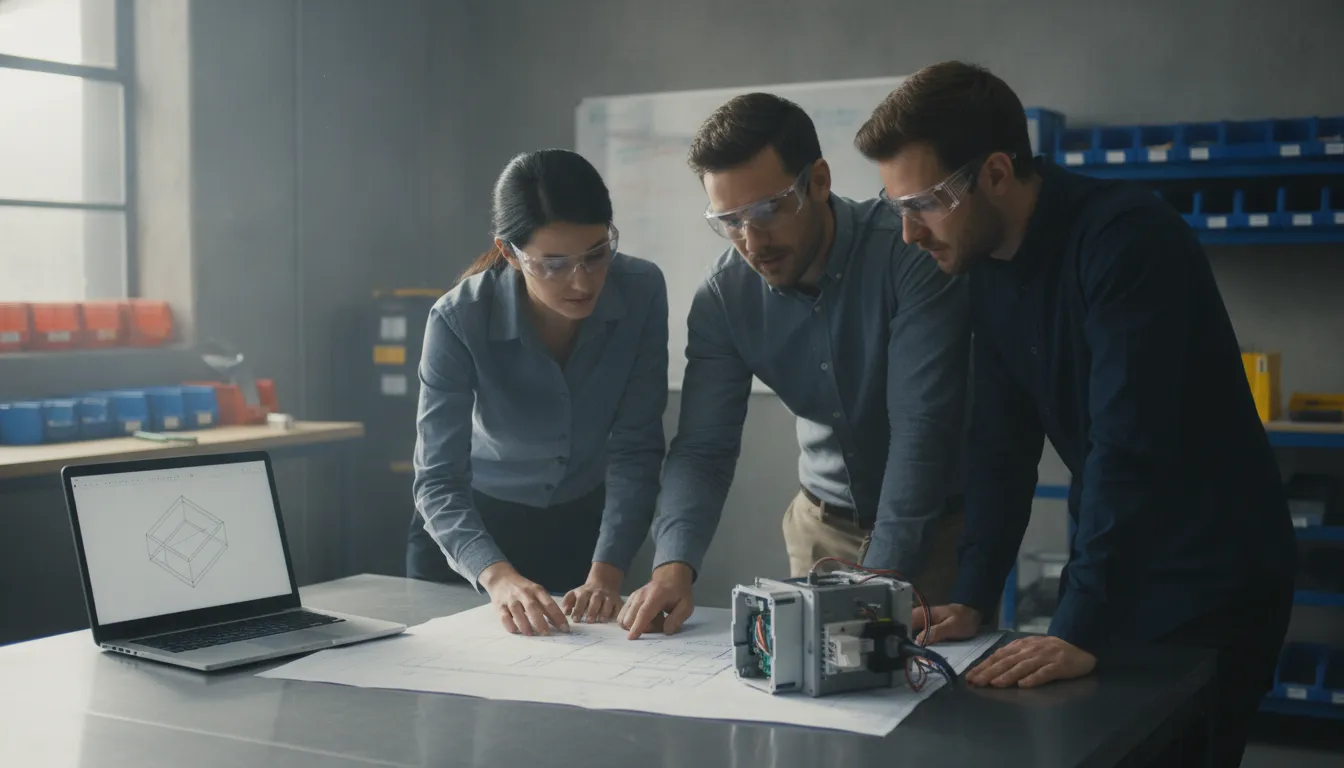
A design review checklist is the agenda a product team uses before it spends money on a tool, a revision, or a second source. The meeting has one job. It decides whether the drawing, the model, and the manufacturing path still agree, and it writes down who owns the next change. It is not a second design project, and it is not a lesson in wall thickness or draft.
Call (407) 377-6899 to request a quote when the packet is ready and you want a manufacturer in the room.
OEM engineering, sourcing, and program leads use this meeting when a part is real enough to argue about and still cheap enough to change. EMS Technologies runs that conversation as part of contract manufacturing: mechanical and electronic production, in-house engineering, and one program manager from the request for quotation through shipment. When the open item is the mechanical design itself, design engineering support is the page that carries the work from the idea to a build. Industrial programs are one application EMS serves, and they often join a housing, a metal part, and a board in one unit.
What a design review checklist decides
The checklist is a decision record. It names the product, the revision, the process under discussion, and the question the room is allowed to close. If the room cannot name those four things, the meeting is a status update.
Three outcomes are enough:
- Accept the packet and move to tooling, a prototype build, or a quote.
- Return the packet with named changes and a named owner.
- Stop. The process, the material, or the volume is still an open choice, so a tool should not be cut.
That is a different job from design for manufacturability. The manufacturability guide checks geometry, material, tooling, and assembly against a chosen process. Bring that check into the meeting as evidence. Do not turn the meeting into the check. Boothroyd Dewhurst describes manufacturability as designing so a product can be produced efficiently, consistently, and economically. The agenda only asks whether that work is done, and whether the open items are written down.
Keep launch scoring out of the room as well. A readiness assessment covers design maturity, process planning, quality, and launch coordination across a program. This meeting is earlier and narrower. It asks whether this revision is fit to leave the conference table.
Who has to be in the room
A design review fails when the only people present are the people who drew the part. The drawing can be consistent and still be wrong for the press, the mold, or the bench.
Seat these roles, even if one person covers two of them on a small team:
- Design owner. Holds the master model, the revision, and the features that are critical to function.
- Manufacturing engineer. Speaks for the process that will actually make the part.
- Quality. Speaks for inspection, test, and the records the customer will ask to see.
- Program owner. Keeps actions, dates, and the commercial path in one place.
- Sourcing or the buyer, when a second source or a tool purchase is on the table.
At EMS Technologies, program management is the seat that keeps those voices in one conversation. One program manager represents the requirements across engineering, manufacturing, quality, and logistics. The same person can cover a simple subassembly or a more integrated system. The page is a framework, not a promise of a fixed schedule.
Electronics belongs in the room when the unit has a board, a cable, or a wound component. A housing review that never sees the connector keep-out will approve a model the bench cannot build. Design engineering support at EMS covers systems, electrical, mechanical and industrial design, and software and embedded work, so the mechanical owner is not the only discipline that can speak.
The packet the meeting is allowed to open
Do not start from a slide. Start from the files the factory will open. A missing file is an action, not a topic to talk around.
| Packet item | Why the review needs it | What "missing" means |
|---|---|---|
| 3D model and drawing, with revision. | The room must know which file is master. | Two versions, or a PDF with no model. |
| CAD format and version. | The toolmaker has to open the file. | A note that says CAD, with no format named. |
| Material or alloy family. | Process choice depends on it. | A brand name, or the word metal. |
| Annual volume and the unit of measure. | A few hundred pieces and a production run need different tools. | Volume left open while a tool is requested. |
| Critical features and datums. | Quality can only inspect what is marked. | Every dimension treated as critical. |
| Related assembly. | A board, cable, or magnetics part may drive the housing. | The part reviewed as if it ships alone. |
Match the extra sheets to the process you think you are buying. A molded part needs color and the molding method. A stamping needs thickness. A casting needs the alloy preference and the finish. A machined part needs the surfaces that are datums and the surfaces that are cosmetic. The tooling discussion at EMS starts from that package: part concept or sample, drawing or model, intended process, mold specification, and the working life you expect from the tool.
You do not need a finished specification to ask for the meeting. The design and engineering page says to bring the concept or the drawings, the design problem, the development stage, and the manufacturing context. Bring the open questions in the same packet. Hiding them until the quote arrives only moves the argument to a more expensive week.
Questions the checklist must close
Read these in order. Stop when an answer is "we will decide later" on an item that changes the tool.
- What is the single primary process, and what annual volume makes that process the right one?
- Which file is the master, who owns it, and which CAD format and version will the toolmaker open?
- Which features are critical to function, and which are leftovers from a prototype method?
- Does the material family match that process, or is the material still a preference from the last program?
- Which operations can live in the tool, and which need a later machine cut, a weld, or a bench step?
- Where does the electronic assembly sit, and can it be tested before the cover closes?
- What must the first-shot or first-article report include, and who signs a change after the tool is cut?
- What is the reporting cadence for tool build, and who receives it?
Question five is where teams smuggle a second process into the note "or machine it." Say the path. If two processes are still open, hold two reviews. Do not average them into one tool.
Question eight is a program decision, not a courtesy. EMS asks teams to agree on the reporting cadence, including tool-building updates and first-shot information. A review that lives only in email will not survive the next revision.
How to run the meeting
Give the meeting a clock and a record. Ninety minutes is enough when the packet arrived the day before. It is not enough when the model is opened for the first time in the room.
Open on the decision, not the history
State the revision, the process, and the decision you want before anyone walks the geometry. History belongs in a pre-read. The room is for the items that can still change the tool.
Walk the interfaces, then the risks
Start where the part meets something else: a mating face, a connector, a fastener, a datum. Then name the production risks that are still open. A risk with no owner is a topic, not a finding.
Write the action in the model
Each action needs an owner, a file to update, and a date. "Design to update the rib" is an action. "Look at manufacturability" is not. The program manager is the person who keeps that list attached to the job, from the quote through test and shipment.
Close with one of the three outcomes
Accept, return, or stop. If the room accepts, name the next commercial step. If it returns the packet, name the revision that will come back. If it stops, name the decision that is still open, such as process or volume, and do not authorize steel.
What this meeting leaves to other reviews
A useful checklist is short because other work already has an owner.
- Process rules for molding, stamping, die casting, or machining stay on those guides. Use them once the process is chosen.
- Partner selection, scorecards, and contract terms are a different meeting.
- New product introduction owns the path from a defined product to a quote and a controlled change. Do not restage that path here.
- Quality system design is not the agenda. Bring the inspection criteria. Leave the system on the quality control page.
Quality at EMS is defined around the product. The page asks for critical features, inspection criteria, required tests, and the traceability you need. Incoming checks, in-process checks, AOI and X-ray where the assembly calls for them, and a final QA record are the shape of that work. The documented certificate is ISO 9001:2015, certificate TW12/11435, for production management of electro-mechanical products. That scope is the certified entity on the certificate. It is not a claim that every plant, every process, or a medical or automotive program carries an extra approval.
Production geography is a project discussion, not a line on this checklist. For smaller complex tooling programs, the tooling page describes development and a test series starting in Taiwan before the tool moves to China for production. That route is not the path for every program. Ask about it when the part is small and complex. Do not write it into the checklist as a default.
A record the next revision can read
Leave the meeting with one page, not a transcript. The page should stand alone for someone who was not in the room.
- Product, revision, and the file name that is master.
- Process, material family, and annual volume used for the decision.
- Outcome: accept, return, or stop.
- Open actions, each with an owner and a date.
- The report you expect at first shot or first article.
- The person who may sign a change after the tool is cut.
Store that page with the model. A slide deck in a shared folder is how a rib moves twice. Program management is where EMS keeps the note tied to quotation, engineering, procurement, testing, and shipment. Use it when the actions cross more than one process, which they usually do on an electromechanical build.
If the model is ready and the process is still a question, bring the packet to the meeting before you ask for steel. The checklist will not design the part. It will stop the room from pretending the part is already decided.
Call (407) 377-6899 or book a meeting. Bring the drawing, the material, and the volume.
Frequently asked questions
What is a design review checklist?
It is the agenda and the record for a design review meeting. It lists who attends, which files are in the packet, which decisions the room must close, and how each action is written down. It does not replace a drawing or a process design guide.
How is a design review different from design for manufacturability?
Design for manufacturability checks whether a chosen process can make the part. The design review decides whether that check is done and whether the team accepts, returns, or stops the revision. Use the manufacturability guide as an input. Do not rerun every geometry rule in the meeting.
When should a product team hold the review?
Hold it when the model is real enough to discuss and before a production mold, die, or fixture is cut. Hold it again when the process changes, a second source is added, or a revision moves a feature that affects the tool. Earlier concept work is product definition, not this meeting.
What should we send before the meeting?
Send the model and the drawing with the revision, the CAD format and version, the material or alloy, the annual volume, and the features that must be held. Add the related board, cable, or assembly if they share the unit. A partial packet is acceptable if the gaps are listed as open items.
Who signs a change after the tool is cut?
Name that person in the review record before the meeting ends. A verbal note that the supplier will sort it out leaves gate location, draft, and texture to the tool. The program owner should keep the signed change with the model and the test report.